
Why Converged Services and Vendor Management Matter for Modern Businesses
For many small and mid-sized businesses, technology does not fail because the tools themselves are poor. It often fails because too many disconnected providers are involved.
One company manages the IT support. Another handles cybersecurity. A different supplier looks after printers. Another manages phone systems. Someone else supplies video conferencing, collaboration tools, internet services, or document workflows.
Individually, each provider may be doing their job. But collectively, the business is left with a fragmented technology environment where no single partner has full visibility or accountability. When something goes wrong, responsibility becomes unclear. Issues are passed between suppliers. Internal staff are forced to coordinate conversations, repeat information, chase updates, and make decisions without a complete picture.
For business owners, executives, and operations managers, this creates unnecessary complexity. Technology should make work easier, not create another layer of administration.
This is where converged services and structured vendor management become increasingly important.
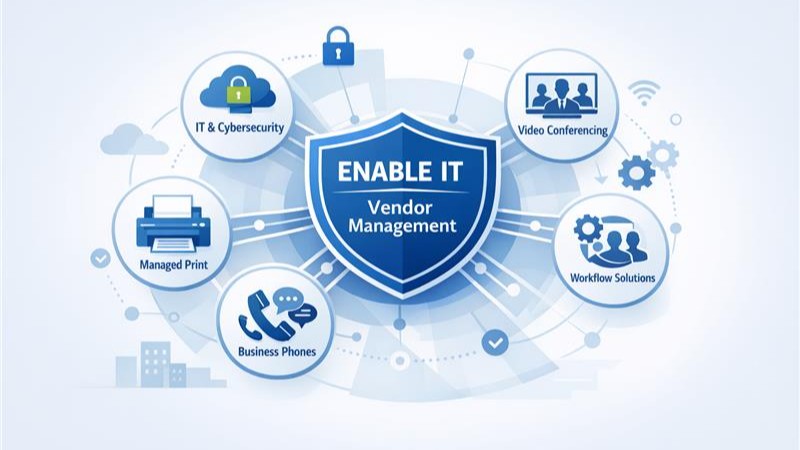
At Enable IT Services, we have formalised this approach through our Vendor Management Program, helping businesses bring greater clarity, coordination, and accountability across their full technology environment.
What Are Converged Services?
Converged services refer to the coordination and management of multiple technology-related services under one strategic approach. Rather than treating IT, cybersecurity, print, phones, video conferencing, document workflows, and workplace technology as separate silos, converged services bring them together as part of one connected ecosystem.
This does not mean every existing supplier must be replaced. In many cases, businesses already have vendors that are delivering good value. The issue is not always the quality of the individual supplier, but the lack of coordination between them.
A converged services model focuses on alignment. It ensures that each technology service supports the broader business strategy, security requirements, operational needs, and user experience.
For example, a business may have a reliable phone system, a separate managed IT provider, and a print provider that delivers good service. But if these systems are not managed with shared visibility, the business may still experience problems. Staff may have inconsistent support experiences. Security policies may not align across platforms. Responsibility may be unclear when a device, network, application, or communication tool stops working.
Converged services aim to solve this by making technology work as a system, rather than a collection of disconnected parts.
The Problem with Too Many Disconnected Vendors
As businesses grow, their technology environments often become more complex. New systems are added over time. Different departments choose different tools. Suppliers are engaged for specific needs. Contracts are signed at different stages, often without a long-term technology roadmap.
This is common, especially for small and mid-sized businesses that have evolved quickly or adopted new tools in response to changing work patterns.
The challenge is that vendor sprawl creates hidden costs and operational risk.
When multiple providers are involved, businesses often face:
- Unclear responsibility when issues arise
- Multiple support channels and escalation points
- Overlapping services and unnecessary costs
- Inconsistent cybersecurity standards
- Poor communication between suppliers
- Delays in resolving technical problems
- Internal staff spending too much time managing vendors
- Limited visibility across the full technology environment
A common example is when a staff member has an issue with a video conferencing system. The problem could relate to the device, the network, the internet connection, the meeting platform, the room hardware, user permissions, or security settings. If each component is managed by a different provider, the business may be left trying to work out who is responsible.
The result is frustration, downtime, and finger-pointing.
For leadership teams, this is not just a technical inconvenience. It becomes a business productivity issue.
Why Vendor Management Matters
Vendor management is the process of coordinating, overseeing, and holding suppliers accountable to ensure they deliver value and support business outcomes. In the context of business technology, it means having one accountable partner who understands the full environment and can manage the moving parts on behalf of the client.
At Enable IT Services, our Vendor Management Program is built around a simple principle: clients should have one accountable technology partner, even when multiple vendors are involved.
This does not mean removing every existing supplier. Instead, it means creating structure, visibility, and ownership.
Where existing vendors are performing well, we work with them. We coordinate communication, manage escalation, align services to the broader strategy, and help ensure expectations are clear. Where there are gaps, duplication, performance issues, or opportunities for improvement, we provide recommendations based on the client’s best interests.
This approach gives businesses the benefit of specialist suppliers without the burden of managing every supplier relationship internally.
One Accountable Partner for the Whole Technology Environment
The key advantage of a vendor-managed approach is accountability.
When a business has one central partner responsible for coordinating technology, issues are easier to manage. Staff know who to contact. Leadership knows who owns the outcome. Suppliers are managed through a clear process. Decisions are made with full context.
Instead of having separate conversations with multiple vendors, the business can rely on one team to understand the bigger picture.
This creates practical benefits across the organisation.
For users, support becomes simpler. They do not need to know whether an issue relates to IT, phones, printers, internet, or conferencing equipment. They can report the issue and trust that it will be managed appropriately.
For management, reporting and planning become clearer. Technology decisions can be made with visibility across cost, risk, performance, user experience, and future requirements.
For suppliers, expectations become more structured. Roles, responsibilities, escalation paths, and service requirements are better defined.
For the business as a whole, technology becomes easier to live with.
How Converged Services Improve Cybersecurity
Cybersecurity is one of the most important reasons to consider a converged services model.
Modern cyber risk does not sit neatly inside one system. It can involve email security, user access, endpoint devices, cloud platforms, phone systems, networks, printers, remote work tools, and third-party applications.
When these services are managed separately, security gaps can appear between vendors.
For example, a print device may be connected to the network but not reviewed as part of the broader cybersecurity strategy. A phone system may have user accounts that are not aligned with the organisation’s identity management policies. A video conferencing platform may be configured separately from broader access controls. A document workflow may create data handling risks if it is not properly secured.
These gaps are not always obvious, but they can increase risk.
A converged approach helps ensure cybersecurity policies are applied consistently across the technology environment. It also allows security considerations to be included in everyday technology decisions, rather than being treated as a separate layer added afterwards.
This is particularly important for small and mid-sized businesses, where internal teams may not have the time or resources to review every vendor, system, and configuration in detail.
The Australian Cyber Security Centre continues to highlight the importance of consistent cybersecurity practices across business systems and vendors.
By bringing IT, cybersecurity, workplace technology, and vendor coordination together, businesses can reduce blind spots and strengthen their overall security posture.
Supporting the Hybrid Workplace
The modern workplace depends on more than traditional IT support. Staff use cloud platforms, mobile devices, business phone systems, video meetings, shared documents, printers, collaboration tools, and remote access systems every day.
When these tools work well together, staff can focus on their work. When they do not, productivity suffers.
Hybrid work has made this even more important. Employees expect technology to function reliably whether they are in the office, working from home, meeting with clients, or collaborating across locations.
A converged services approach supports this by ensuring workplace technology is planned and managed as part of the broader IT environment.
Video conferencing rooms, phone systems, document workflows, and print solutions should not sit outside the technology strategy. They are part of how people communicate, collaborate, share information, and serve clients.
When managed together, businesses can improve reliability, reduce friction, and create a better user experience.
When Should a Business Consider Vendor Management?
A vendor-managed approach may be valuable if your business has multiple technology suppliers but limited internal time to manage them.
Common signs include:
- You are unsure which vendor is responsible when something goes wrong
- Staff are frustrated by inconsistent support experiences
- Technology issues are regularly passed between providers
- You have separate suppliers for IT, cybersecurity, phones, print, or conferencing
- Leadership spends too much time coordinating technical conversations
- You suspect there is duplication across services or contracts
- Cybersecurity responsibilities are unclear across vendors
- Your technology works, but feels harder than it should
These issues are common, and they do not always mean your current suppliers are doing a poor job. Often, the missing piece is coordination.
Vendor management provides that missing structure.
Making Technology Simpler, Smarter, and Easier to Manage
Converged services are not about making technology bigger or more complicated. They are about making it simpler, smarter, and easier to manage day to day.
For businesses that rely on multiple systems and suppliers, the goal is not to remove flexibility. The goal is to create alignment.
With the right vendor management approach, businesses can keep the value of specialist providers while gaining the clarity of one accountable technology partner.
At Enable IT Services, our Vendor Management Program is designed to help clients reduce complexity, improve accountability, and create a more connected technology environment across IT, cybersecurity, print, phones, video conferencing, document workflows, and workplace technology.
Technology should support your business, not slow it down.
If your technology works but feels harder than it should, or if you have too many vendors and not enough clarity, a vendor-managed approach may be the missing piece.
Speak to Enable IT Services about how our Vendor Management Program can help simplify your technology environment and create clearer accountability across your business.
