
Phishing remains one of the easiest ways for cybercriminals to get into a business, and for many Perth SMEs it is still one of the most likely day-to-day cyber risks. Modern phishing attacks are designed to look normal, arriving as invoices, password resets, shared files, or urgent requests that appear to come from someone you trust.
That is why the human firewall and employee awareness matters. You can have strong security tools in place, but if someone is rushed, distracted, or unsure what to look for, one click can still create a serious issue. A strong human firewall helps close that gap by teaching staff to pause, question, and report suspicious activity early.
For Perth businesses using Microsoft 365, cloud platforms, email, and remote access every day, this matters even more. Many SMEs run with lean teams and people wearing multiple hats, so cyber security cannot rely on technology alone. It needs the right mix of protection, process, and user awareness.
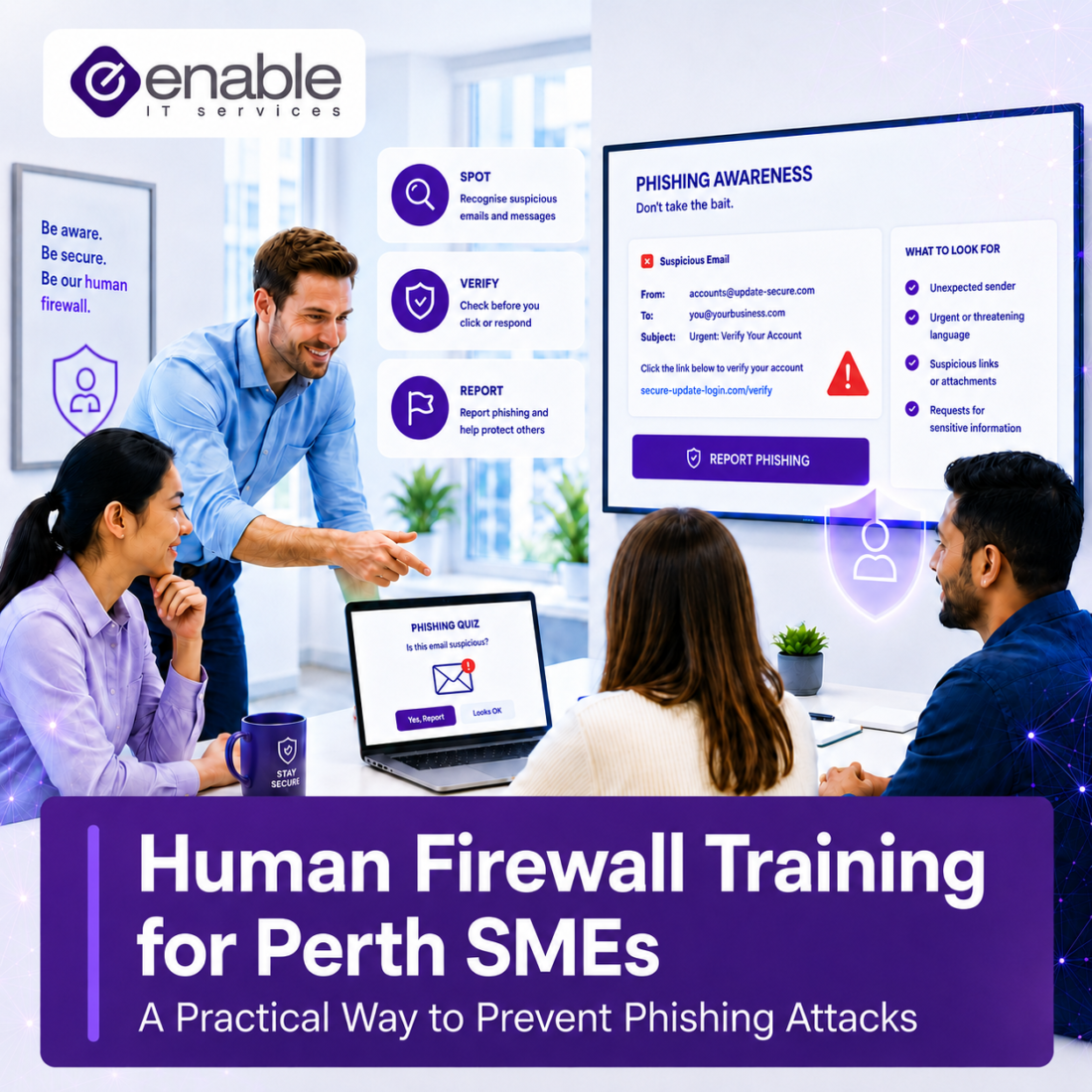
Why Phishing Prevention Requires More Than Technology
Most businesses do invest in the right tools, including antivirus, email filtering, MFA, backups, firewalls, and monitoring. These are all important. The challenge is that attackers do not always break the technology directly. More often, they try to trick a person.
That might look like a fake supplier invoice, an urgent payment request, a convincing Microsoft 365 sign-in page, or an attachment designed to create panic. Modern phishing emails are often polished and believable, which is exactly why awareness training is so important.
What Is a Human Firewall?
A human firewall is a workforce that knows how to recognise, question, and report cyber threats before they become incidents. It does not mean every employee needs technical expertise. It means they understand warning signs and know what to do when something feels off.
In practical terms, that means staff pause before approving payments, double-check links before signing in, question unusual requests for sensitive information, and escalate suspicious emails instead of ignoring them. These small habits can stop a major issue before it spreads.
Why Human Firewall Training Matters for Perth SMEs
Small and medium businesses are often targeted because attackers know they are busy and may not have a dedicated in-house cyber security team. In many Perth organisations, one person may be handling accounts, admin, procurement, and client communication at once. That makes employee awareness a critical part of phishing prevention.
A single compromised Microsoft 365 account can lead to mailbox access, fraudulent emails, stolen data, and disruption across the business. The impact is not just technical. It can also affect trust, invoicing, and day-to-day operations.
The Real Cost of Getting It Wrong
When a phishing attack succeeds, the cost can escalate quickly. Financial loss is often the first concern, but businesses can also face downtime, data exposure, emergency remediation work, and reputational damage with customers or suppliers.
Australian cyber security guidance continues to highlight that small businesses are frequent targets. The positive news is that many common attacks are preventable when businesses combine sensible technical controls with practical staff awareness and clear internal procedures.
What an Effective Human Firewall Looks Like
An effective human firewall is built over time. It starts with regular awareness training that is simple, practical, and relevant to the roles people perform every day.
- Short, regular cyber awareness training
- Phishing simulations to reinforce good habits
- A clear reporting process for suspicious activity
- Fast support when someone clicks something they should not
Awareness is strongest when it is backed by technical controls such as MFA, email protection, secure device management, role-based access, and monitoring. Awareness and technology work best together.
A Practical First Step: Free Cyber Wardens Training
One practical starting point for many Australian small businesses is the Cyber Wardens program. It is a free, government-backed training option designed to help small business owners and staff improve everyday cyber awareness in plain English.
For time-poor SMEs, this can be a useful first step. It helps staff recognise common red flags and build safer habits without adding major cost or complexity.
Training is only one layer, though. Businesses still need strong email security, Microsoft 365 protection, access controls, backups, endpoint protection, and a practical response plan. This is where managed IT support can help turn awareness into a broader defence strategy.
Why Cyber Security Awareness and Managed IT Services Work Best Together
Technology protects systems, but awareness protects behaviour. A business can have strong tools in place and still be exposed if staff do not recognise a scam. On the other hand, even a well-trained team will struggle if accounts are not protected properly.
For Perth businesses, the goal is a balanced approach that combines staff awareness with identity security, email protection, endpoint controls, backups, and fast response. That is why many SMEs work with a managed IT services provider to help align cyber security with day-to-day business operations.
Frequently Asked Questions
What is a human firewall in cyber security?
A human firewall is a workforce that knows how to recognise, question, and report cyber threats before they become incidents. For Perth SMEs, it means staff are trained to spot phishing emails, suspicious links, unusual payment requests, and fake Microsoft 365 login pages before damage is done.
How can Perth SMEs prevent phishing attacks?
Perth SMEs can reduce phishing risk by combining employee cybersecurity awareness training with multi-factor authentication, email filtering, strong access controls, secure backups, device protection, and ongoing monitoring. The strongest approach combines people, process, and technology.
How often should staff complete cyber security awareness training?
Cyber security awareness should not be treated as a once-a-year exercise. A better approach is regular short training, ongoing reminders, and occasional phishing simulations so staff continue to build confidence and stay alert to changing threats.
What should an employee do if they click a phishing link?
They should report it immediately. Fast reporting gives your IT provider or internal team the best chance to contain the issue, reset credentials if required, review device activity, and reduce the chance of a wider compromise.
Why should a Perth business use managed IT services for cyber security?
A managed IT services provider can help combine staff awareness, Microsoft 365 security, endpoint protection, backup strategy, and fast response into one practical cyber security approach. For many Perth businesses, that makes it easier to reduce risk without building a full in-house IT security team.
Final Thoughts
The next cyber incident your business faces is unlikely to begin with a dramatic technical failure. More often, it starts with a normal-looking email and a rushed decision. That is why building a strong human firewall is such a practical investment for Perth SMEs.
If you want to reduce cyber risk, the strongest approach is to combine awareness training with the right technical protections and a clear response plan. That creates a more resilient business and reduces the chance that a simple phishing attempt turns into a costly incident.
Want to reduce cyber risk for your Perth business?
Book a cyber security review with Enable IT Services in Perth to identify phishing, Microsoft 365, and user awareness risks across your business.
Original concept article:
The Human Firewall: How Employee Awareness Prevents Costly Cyber Incident
